

Since 1945 with the invitation of curb cuts in Kalamazoo, Michigan, accessibility advocates and urban planners have struggled to get the balance right for how to make a truly inclusive transportation system.
The latest impact has been from the development of ridesharing services and, even more recently, autonomous vehicles from companies like Waymo and Zoox.
For many riders, these developments are a technological novelty and a real convenience. But for some people with disabilities (especially those who are blind or have low vision), what’s at stake is independence itself.
The trouble with rideshares
Modern rideshare platforms like Uber and Lyft promised frictionless transportation and have their accessibility improvements to be sure. Wheelchair users, for example, can order a Wheelchair Accessible Vehicle from Uber and that can be effective. But for riders who are blind and travel with guide dogs, a typical rideshare service has its drawbacks.
Lucy Greco knows this conversation well.
An accessibility expert based in the San Francisco Bay Area, Lucy is blind and travels with a guide dog. Like many disabled riders, she relies on rideshare services to move through the city independently. Federal law is clear: drivers cannot refuse service to riders with guide dogs. In practice, however, refusals still happen. Sometimes subtly, sometimes openly.
In Lucy’s experience, drivers have refused rides altogether after arriving and seeing her service dog. Worse still, Lucy recalled one instance when she and a friend had already settled into a rideshare vehicle before the driver pulled over moments later and forced them out because of her guide dog.
Autonomous vehicles as a solution
These problems are simply eliminated with self-driving car services like Waymo and Zoox. “Autonomous vehicles remove the biggest challenge I face with ridesharing apps,” Lucy said. “There is no human element that can look at me and my guide dog and deny us the ride. The robot doesn’t care, and it will get me where I need to go without a fight.”
For the first time, access does not depend on convincing another person to follow the rules. This is not a small thing, bringing at least one blind rider to tears of joy. With autonomous vehicles, the car arrives, the ride happens, and the negotiation disappears.
Independence born from inclusivity
In the San Francisco Bay Area, where Waymo operates fully driverless rides, requesting a car feels less futuristic and more “normal” by the day. Riders tap an app, wait for a few minutes, and – ding! – a notification comes that the vehicle has arrived. But the experience quickly diverges from a traditional rideshare. There is no driver scanning the curb, no moment of eye contact, no hesitation about a guide dog climbing into the back seat. The car simply arrives, ready for its passenger.
One of the most meaningful differences happens before the ride even begins. When a Waymo vehicle pulls up, the car emits an audible signal that riders who are blind can follow toward the door. No more searching for the car, and no need to ask strangers for help.
That detail, easy to overlook unless you need it, exists because accessibility leaders helped shape it. A patent behind Waymo’s vehicle-location system describes using external speakers to generate directional audio cues that guide passengers toward an autonomous vehicle during pickup. The feature was co-developed by Kiran Kaja, an accessibility leader and principal product manager at Amazon (incidentally, an Evinced customer).
A Zoox accessibility review
The quest for autonomy in autonomous vehicles was what brought Lucy and me to Las Vegas, where Zoox is offering free test rides at select locations before launching in more metro areas.
Zoox, a startup acquired by Amazon in 2020, is still in early days and has hardly advertised its service as accessible. But we thought an early look, and comparison with Waymo, would be interesting.
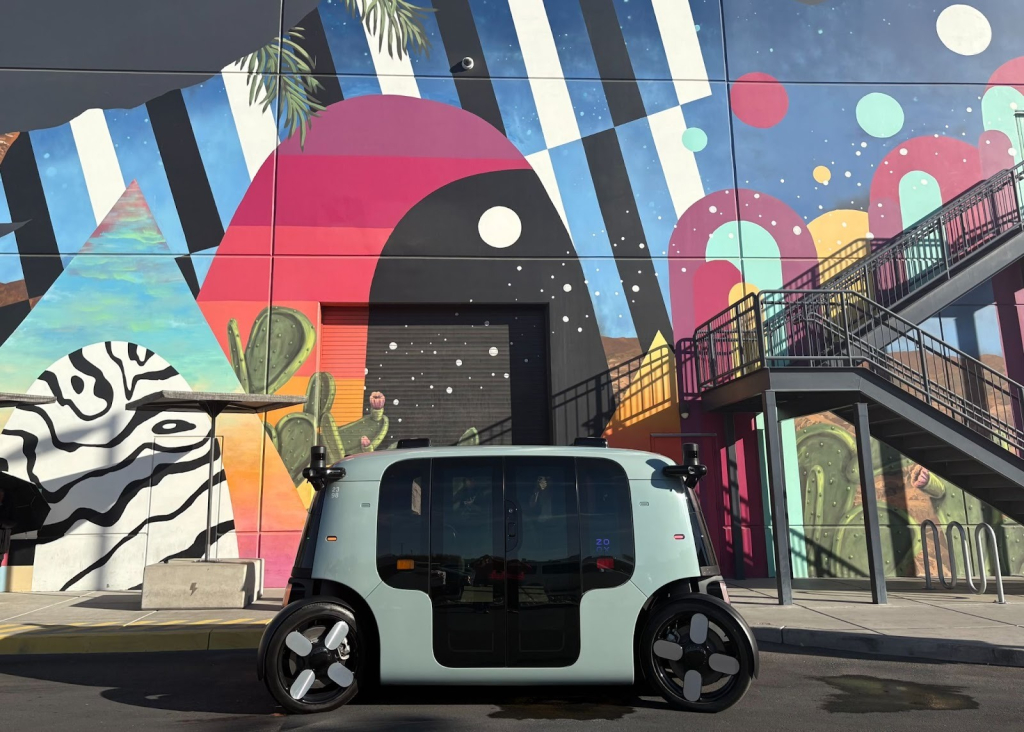
Image: A Zoox autonomous vehicle designed without a steering wheel or driver’s seat, parked at Area 15 in Las Vegas. [Photo: Evinced]
Unlike Waymo, which adapted existing vehicles into autonomous fleets, Zoox is attempting something more radical: a vehicle designed entirely around autonomy from the ground up. There is no steering wheel, no driver’s seat, and no obvious front or back. Inside, four passengers sit facing one another in a symmetrical cabin meant to feel less like a car and more like a living room.
On paper, the design suggests lots of accessibility potential. Wide sliding doors open fully on both sides, like a van. The spacious interior appears large enough to accommodate service animals or mobility aids comfortably. Zoox describes their vehicles not as a car, but as a “robotaxi” designed around the rider. But, which riders?
The vehicle wasn’t lacking ambition. With no steering wheel or true front or back, it never needs to reverse or back out of a corner. It simply took off in the direction it needed to go based on the route we requested.
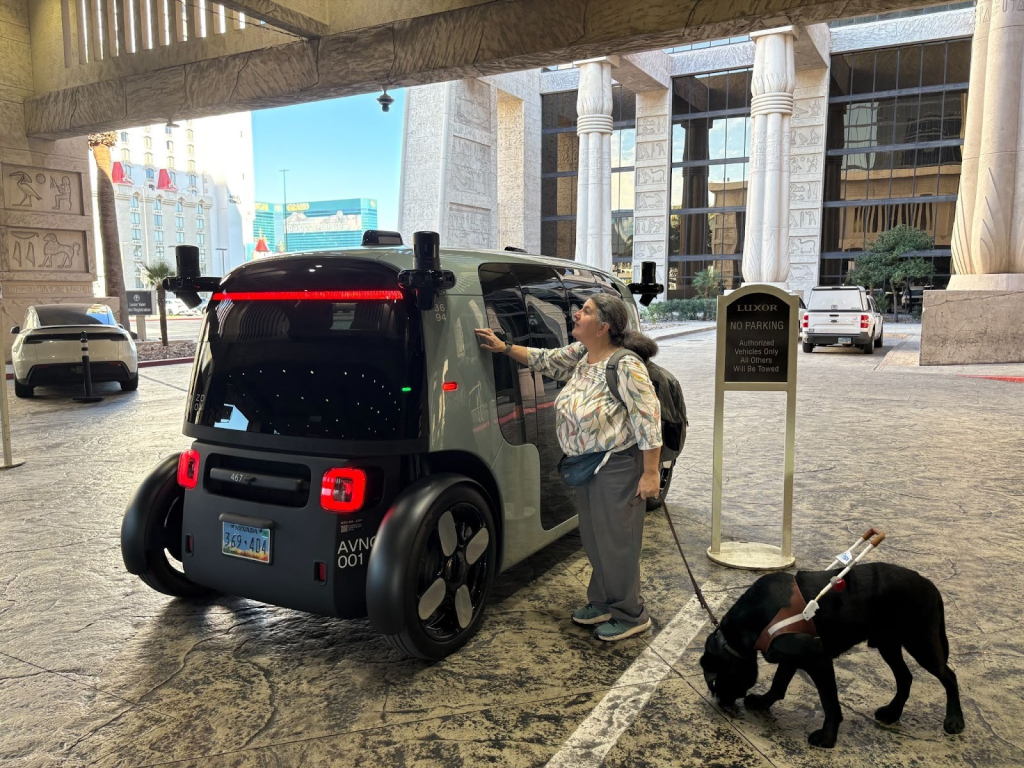
Image: Lucy Greco feels for a door on the Zoox robotaxi with her right hand while holding her service dog’s leash with her left hand. [Photo: Evinced]
But there were some definite accessibility problems still needing to be worked through. Where Waymo guides riders through sound, the Zoox vehicle relied heavily on sight. After entering the cabin, Lucy paused, waiting for cues that never came. There was no auditory prompt indicating where to sit, no spoken instruction explaining how to begin the ride. A total of four tablets, each mounted next to a seat inside the cabin, controlled the experience, including a large illuminated button used to start the trip. But there was no obvious way for a blind rider to locate it.
Even entering the vehicle introduced uncertainty. Though Zoox describes the cabin as curb-level, the car often stopped several feet away from the sidewalk. Without a grab bar or tactile cue, stepping into the cabin required guesswork, a minor inconvenience for sighted riders, but a meaningful obstacle for someone navigating without visual reference.
Inside, the only Braille labeling appeared on the emergency call button mounted overhead. When Lucy attempted to read it, the light pressure of her fingers accidentally triggered a call to emergency support. We quickly explained what had happened and were asked not to activate the button again unless there was an emergency. Whoops!
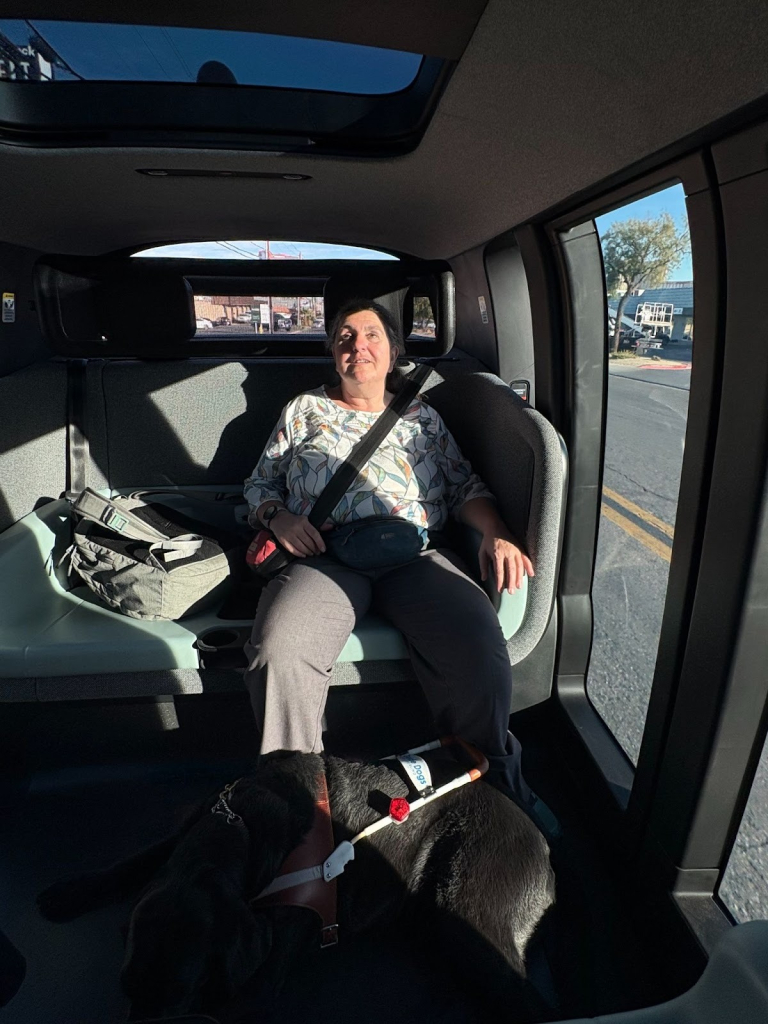
Image: Lucy Greco and her service dog ride in a Zoox robotaxi in Las Vegas. [Photo: Evinced]
For Lucy, the contrast with Waymo was obvious. While rides in both types of vehicles were comfortable, one system quietly anticipated her needs and the other required interpretation and some assistance. By the end of the day, the Zoox technology felt impressive, but independence felt uneven. That said, none of the product design issues we encountered seemed insurmountable and we hope that accessibility is high on the list for Zoox as it evolves.
Systemic challenges remain
Autonomous vehicles also face accessibility challenges from systemic issues, too.
In December 2025, a power outage in San Francisco disabled traffic signals across multiple neighborhoods. Waymo temporarily suspended its service as videos circulated online showing autonomous vehicles stopped in roadways with hazard lights flashing, stuck in conditions they could no longer interpret. The vehicles behaved cautiously, stopping rather than improvising in an uncertain environment, and no injuries were reported.
But the moment exposed a different kind of vulnerability, pointed out by advocate Erik Knaresboro from Streets of Equality. Erik expressed deep concern about safety for riders with disabilities in general but especially during situations like system outages. If a vehicle becomes immobilized during a crisis – a storm, an accident, a computer glitch – how will an unsighted rider interpret the changed environment? How do they know whether it is safe to exit, where traffic is moving, or what hazards might be nearby?
The outage didn’t prove that robotaxis are unsafe, but it did highlight something accessibility advocates have long understood: independence doesn’t just depend on how systems act when they work. It also depends on how they act when they fail.
Inclusion before ideation
Autonomous vehicles promise greater independence for many riders with disabilities. But independence has never come from technology alone.
The curb cut reshaped cities because disabled people helped design it, insisting that access be built into the world rather than added afterward. Inclusion works best when it happens early.
As Lucy told me during a Zoox ride, “You start with inclusion before ideation.”
In accessibility work, that principle is often described as shifting left: considering access at the beginning, not retrofitting it later.
Driverless cars are already navigating streets across the Bay Area and beyond. As autonomous transportation expands, the question is no longer whether the technology works, but who it works for and who is invited to help shape it.
If providers don’t do the work of inclusion early in their design and development process, autonomous vehicles may deliver futuristic rides for some, while leaving others still waiting at the curb.


